
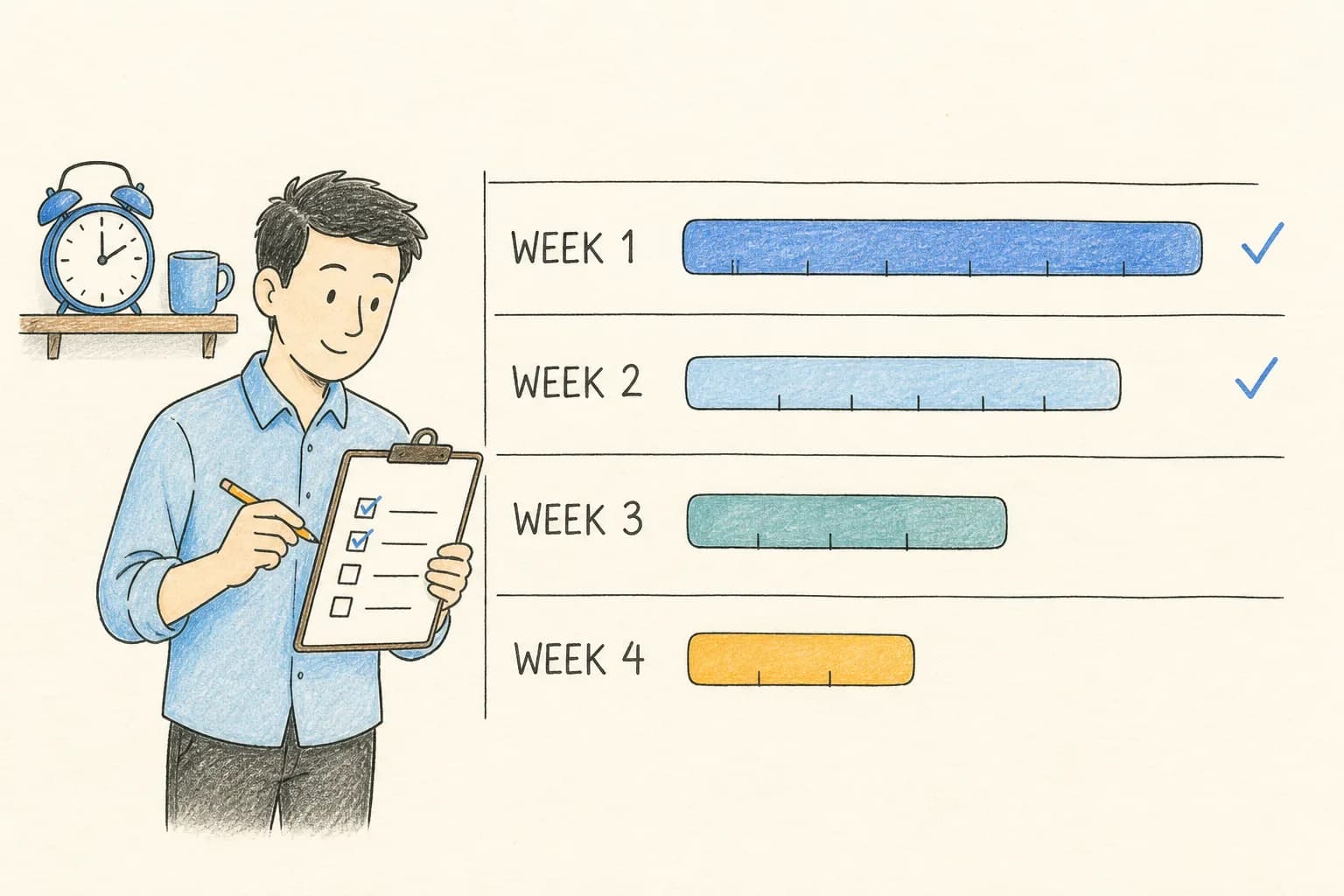
Most PTE Core study plans divide your time evenly across the four skills. That is the wrong shape, because the test itself is not evenly divided. A single test contains 10 to 12 Repeat Sentence items and as few as 1 Reading Multiple Choice, Single Answer item, and several tasks raise two skill scores at once. This four week plan spends your hours where the items actually are: one week to find your baseline and fix speaking volume, one for writing and reading accuracy, one for listening and your weakest skill, and one for full length rehearsal under test conditions.
First, weight the tasks by how often they appear
Before you schedule anything, look at what a test is actually made of. Item counts vary within a range, so plan for the top of each range.
| Task | Items per test | Part |
|---|---|---|
| Repeat Sentence | 10 to 12 | Speaking and Writing |
| Read Aloud | 6 to 7 | Speaking and Writing |
| Answer Short Question | 5 to 6 | Speaking and Writing |
| Reading and Writing: Fill in the Blanks | 5 to 6 | Reading |
| Fill in the Blanks (drag and drop) | 4 to 5 | Reading |
| Describe Image | 3 to 4 | Speaking and Writing |
| Write from Dictation | 3 to 4 | Listening |
| Write Email | 2 to 3 | Speaking and Writing |
| Re-order Paragraphs | 2 to 3 | Reading |
| Listening Fill in the Blanks | 2 to 3 | Listening |
| Respond to a Situation | 2 to 4 | Speaking and Writing |
| Every remaining task type | 1 to 2 each | All three parts |
Three speaking tasks, Repeat Sentence, Read Aloud and Answer Short Question, account for roughly 21 to 25 of the 52 to 67 tasks in a test. Nothing else in PTE Core comes close to that concentration, which is why week one is a speaking week even if speaking is not your weakest skill. The full inventory of all 19 scored task types, with timings, is in the PTE Core test format guide.
The four week shape
| Week | Focus | Main tasks | Checkpoint by Sunday |
|---|---|---|---|
| 1 | Baseline and speaking volume | Repeat Sentence, Read Aloud, Answer Short Question | You know your weakest skill and can record without hesitating on the beep |
| 2 | Writing accuracy and reading pace | Write Email, Summarize Written Text, both Fill in the Blanks tasks | Full Form marks every time, and a repeatable email structure |
| 3 | Listening, plus your weakest skill | Write from Dictation, Summarize Spoken Text, Highlight Incorrect Words | Note taking that survives a single play of the audio |
| 4 | Full length rehearsal | Complete mock tests, then targeted repair | Two full tests finished on time, no unfinished sections |
Week 1: find your baseline, then attack speaking volume
Start with a diagnostic rather than with study. Guessing at your weakest skill costs you the first week of any plan. Sit a full length mock test, or run the shorter diagnostic in the AI Coach, which builds a week by week plan from your results instead of a generic template.
Then spend the rest of week one on the three high volume speaking tasks. Repeat Sentence rewards memory and rhythm rather than comprehension, so practise it in short daily blocks rather than long weekend sessions: 10 to 15 items a day beats 80 items on a Saturday. On Read Aloud, use the 30 to 40 second preparation window to mark where you will breathe, not to read the text silently three times. On Answer Short Question, the only trait scored is whether your word choice is right, and you have 10 seconds, so train the reflex of answering in one or two words instead of a sentence.
Record yourself and listen back at least twice this week. Pronunciation and Fluency share one rubric across the speaking tasks, and Fluency is about rhythm, pauses, repetitions and false starts rather than about accuracy of wording. Most test takers hear their own hesitations immediately on playback and never notice them live.
Week 2: writing accuracy and reading pace
Writing is the skill where fixed rules earn marks fastest, because Form is decided by word count and formatting alone. Summarize Written Text earns full Form marks at 25 to 50 words, Summarize Spoken Text at 20 to 30 words, and Write Email at 50 to 120 words. Practise until you land inside those bands without counting. Also drill the disqualifiers: an otherwise good Summarize Written Text response scores zero for Form if it is written in all capitals, has no punctuation, or is only bullet points.
Build one reusable Write Email structure this week and reuse it every time: purpose, detail, request, close. The task is scored on seven traits, including Email Conventions and Organization, and a structure you do not have to invent under time pressure protects both. Nine minutes is generous only if you are not designing the email from scratch.
For reading, the two Fill in the Blanks tasks are the volume: 9 to 11 items between them. They reward collocation and grammar sense rather than deep comprehension, so practise them in timed sets. Re-order Paragraphs is scored on each correctly ordered adjacent pair, which means a partly correct ordering still earns marks. Never leave it in its original scrambled order.
Week 3: listening, and whatever your diagnostic exposed
Note taking is the real skill you are training in Part 3. Write from Dictation is the highest volume Listening task at 3 to 4 items and it is scored one point per word spelled correctly, which makes it the most improvable task in the section: practise it daily and count your spelling errors, not just your word recall. Summarize Spoken Text gives you 8 minutes to write from audio of 45 to 75 words, so your notes must capture the argument, not the phrasing.
Be careful with Highlight Incorrect Words and both Multiple Choice, Multiple Answers tasks. All three deduct a point for every wrong selection, down to a minimum of zero for the item, so guessing extra options costs marks on these three and nowhere else. Practise selecting only what you are confident about. The mechanics are covered in how PTE Core is scored.
Spend the second half of the week on the weakest skill from your week one diagnostic. Remember that skills overlap: if Writing is your weak point, Write from Dictation and Listening Fill in the Blanks feed it just as Write Email does.
Week 4: rehearse the whole two hours
Task practice does not prepare you for a two hour test. In the final week, sit at least two complete mock tests in one sitting, at the time of day your real test is booked, with a headset and no pauses. What you are testing is stamina and pacing: whether you still speak clearly in Part 3, and whether you finish Reading inside its 27 to 37 minute window without rushing the last two items.
Review each mock the same day, and repair only the two or three task types that lost the most marks. Do not start new material this week. In the last two days, drop the volume and rehearse the routine instead: microphone check, the unscored Personal Introduction, and the transition into Read Aloud.
If you have less than four weeks
Compress rather than skip. With two weeks, run week 1 and week 4 as written and fold weeks 2 and 3 into alternating days. With one week, take a mock on day one, spend days two to five on the three high volume speaking tasks plus Write from Dictation and the Form word counts, and keep the final two days for a second full mock and its review. What you should not do is drop the full length rehearsal, because pacing failures cost more marks than any single weak task type.
Start with your baseline, not with a template
Any plan is a guess until you know your starting point. Sit a free full length mock test for an estimated CLB level across all four skills, try the free Repeat Sentence question to see how the AI scoring reads your response, or let the AI Coach turn your diagnostic results into a week by week schedule. For the detail behind each task, work through the complete Speaking and Writing guide.