
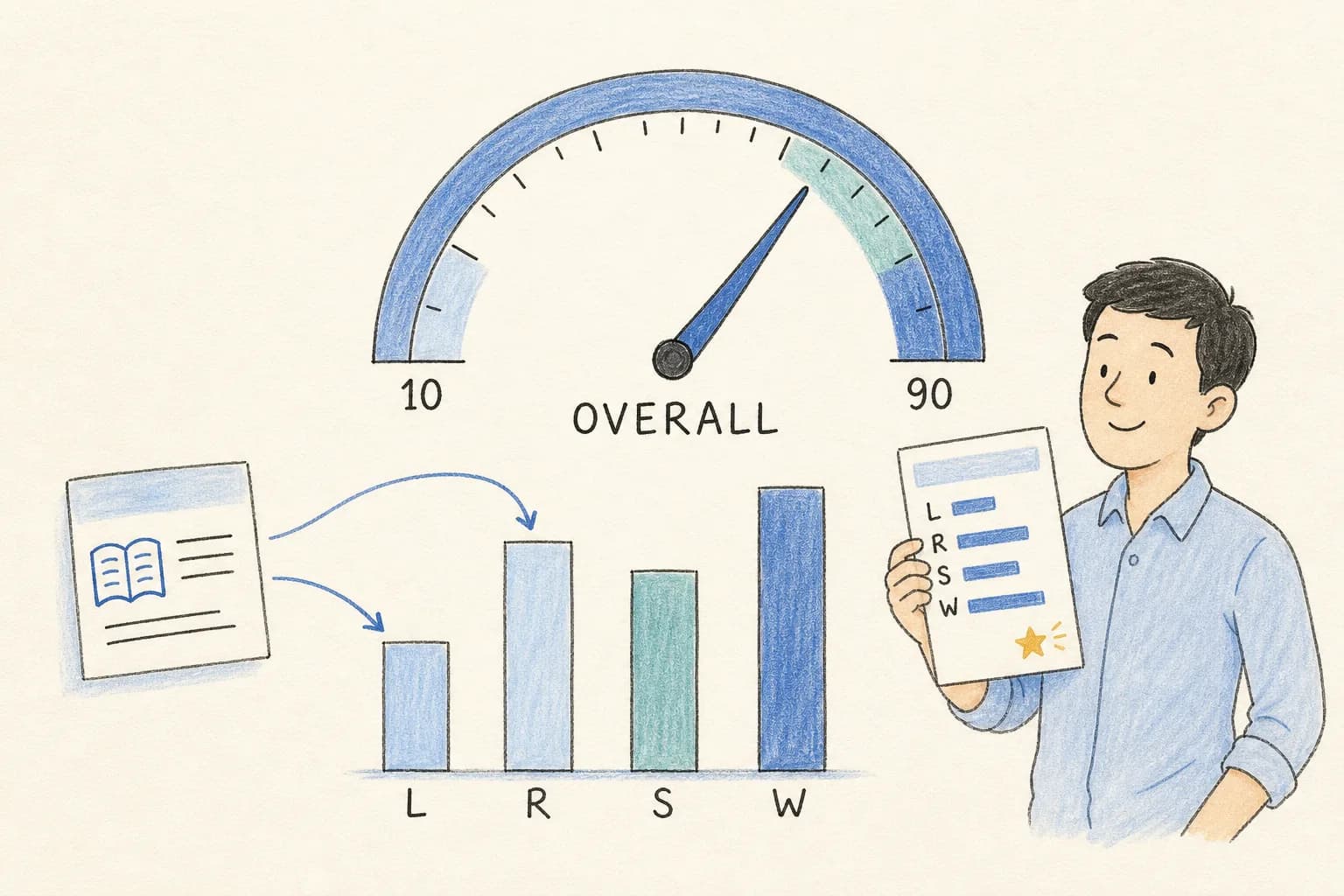
PTE Core reports an overall score and four communicative skill scores, Listening, Reading, Speaking and Writing, each on a scale of 10 to 90. The single most misunderstood fact about that scale is this: your overall score is not the average of the four skill scores. Pearson's Score Guide says so directly. Individual tasks feed the skill scores, several tasks feed two skills at once, and the overall score is produced from your performance across the whole test rather than by averaging four numbers.
What gets reported
Every PTE Core score report carries five numbers on the same 10 to 90 scale: one overall score and one for each of the four communicative skills. There is no pass mark built into the test. What counts as a good score depends entirely on what the organisation receiving it asks for, which for Canadian immigration means a Canadian Language Benchmark level rather than a raw PTE number. The mapping between the two is in the PTE Core score chart.
Why one task can raise two scores
PTE Core uses integrated skills tasks. When a task requires you to read a text and then speak, or listen and then write, its result contributes to both of those communicative skills. This is why the four skill scores cannot be traced back to four tidy blocks of the test, and it is the single most useful thing to know when you decide where to spend practice time. The table below shows which tasks feed which score.
| Communicative skill | Tasks that contribute to it |
|---|---|
| Speaking | Read Aloud, Repeat Sentence, Describe Image, Respond to a Situation, Answer Short Question |
| Writing | Summarize Written Text, Write Email, Reading and Writing: Fill in the Blanks, Summarize Spoken Text, Listening Fill in the Blanks, Write from Dictation |
| Reading | All five Reading tasks, plus Read Aloud, Summarize Written Text and Highlight Incorrect Words |
| Listening | All seven Listening tasks, plus Repeat Sentence and Answer Short Question |
Read the Writing row again. Three of the six tasks that raise your Writing score sit in the Listening section, and one sits in the Reading section. A test taker who practises only Write Email and Summarize Written Text is training half of their Writing score at best. The same logic runs the other way for Reading, where Read Aloud in the Speaking section contributes marks. The full section by section inventory is in the PTE Core test format guide.
Partial credit, correct or incorrect, and the three tasks that deduct points
Pearson publishes a scoring method for every task type. Most tasks use partial credit, which means you earn marks for each correct element rather than passing or failing the item as a whole: each correctly completed blank, each correctly ordered adjacent pair of paragraphs, each word spelled correctly. A few tasks are scored as simply correct or incorrect, including Answer Short Question, Reading Multiple Choice, Single Answer, Listening Multiple Choice, Single Answer, and Select Missing Word.
Three tasks are different again, because their published bands deduct a point for each wrong selection:
- Reading Multiple Choice, Multiple Answers, scored one point for each correct response and minus one for each incorrect response, to a minimum of zero.
- Listening Multiple Choice, Multiple Answers, scored the same way.
- Highlight Incorrect Words, scored one point for each correct word and minus one for each incorrect word, to a minimum of zero.
That minimum of zero matters. You cannot drive an item below zero, so a task you have partly worked out is still worth attempting, but on those three tasks alone, clicking extra options in the hope that one lands actively costs you marks. On the other task types, a wrong selection is not described as deducting anything.
The traits behind each score
Speaking and Writing tasks are not scored as one lump. Each is broken into traits, and the trait list changes from task to task. Across the seven scored Speaking and Writing task types Pearson uses Content, Pronunciation, Fluency, Appropriacy, Vocabulary, Form, Grammar, Email Conventions, Organization and Spelling. Write Email carries the most traits at seven; Answer Short Question carries a single binary Vocabulary trait for correct or incorrect word choice.
Content in particular is not one shared definition. On Read Aloud it counts every replaced, omitted or inserted word as an error against the printed text. On Repeat Sentence it measures how many of the prompt's words you reproduce in the correct sequence, while ignoring hesitations and pauses. On Describe Image it measures how completely you cover the elements of the image and their relationships, with no fixed text to match. Pronunciation and Fluency, by contrast, do share one rubric across the speaking tasks that use them: Pronunciation on how clearly you produce vowels and consonants and where you place stress, Fluency on rhythm, pacing and freedom from hesitations, repetitions and false starts.
Form is arithmetic, not opinion
Three tasks carry a Form trait that is decided purely by the length and formatting of what you write. It is the easiest trait in the test to score full marks on and the easiest to throw away.
| Task | Full Form marks | Partial Form marks |
|---|---|---|
| Summarize Written Text | 25 to 50 words | 5 to 24 words, or 51 to 60 words |
| Summarize Spoken Text | 20 to 30 words | 5 to 19 words, or 31 to 40 words |
| Write Email | 50 to 120 words | Not published |
Two things about Summarize Written Text catch people out. Falling outside the 25 to 50 word band is not automatically a zero, since 5 to 24 or 51 to 60 words still earns a partial mark. But a response inside the ideal band still scores zero for Form if it is written entirely in capital letters, contains no punctuation, or consists only of bullet points, regardless of how good the content is. On Write Email, note that the on screen instruction to aim for at least 100 words is guidance, while the band that earns full Form marks is 50 to 120 words. Those are two different numbers and both are genuine.
Who, or what, does the scoring
PTE Core is automatically scored. Writing responses are scored by Pearson's Intelligent Essay Assessor, built on the Knowledge Analysis Technologies engine and using Latent Semantic Analysis. Speaking responses are scored by Pearson's Versant speech processing technology. Human expert scorers are still involved, but their role is to train the automated engines on every speaking and writing item type, not to mark your individual live test.
Those engines were originally developed for PTE Academic, from which PTE Core was adapted, and were trained on a field test of more than 10,000 test takers from 38 cities in 21 countries, representing 158 nationalities and 126 first languages. That is the practical reason a machine can grade a strong response delivered in an unfamiliar accent: the training data was deliberately built to be accent diverse. The relationship between the two tests is covered in PTE Core vs PTE Academic.
Turning a score into a CLB level
For Canadian immigration your PTE Core numbers only matter once they are converted to Canadian Language Benchmarks. Pearson publishes an alignment table for that conversion, and repeats twice in the same document that IRCC's website is the authority on what your specific application requires, and that the table itself is reviewed periodically. Use the conversion chart guide to see where your target sits, then confirm the requirement against the official IRCC pages before you book.
Practise against the same traits the test uses
Reading a rubric is not the same as being measured against it. Exam Hero grades Speaking and Writing responses on the same official traits Pearson lists for each task, with Form and Spelling calculated from your response rather than estimated. Try the free Write Email question to see a trait by trait breakdown, read the complete Speaking and Writing guide for what each trait rewards, or sit a full mock test for an estimated CLB level across all four skills.