
PTE Core Speaking and Writing: The Complete Guide
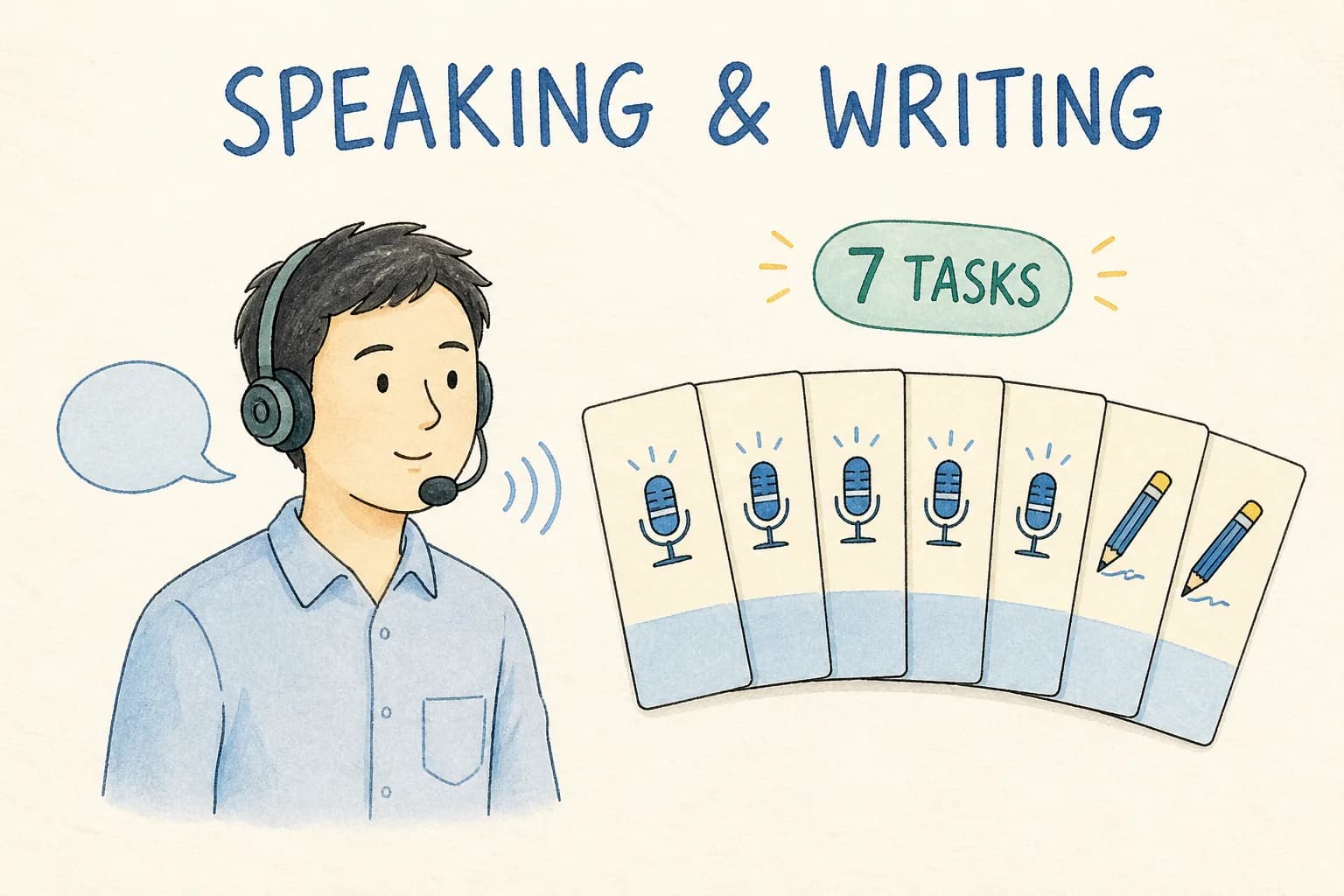
PTE Core's Speaking and Writing section, officially Part 1 of the test, runs 50 to 65 minutes and covers eight task types: seven that count toward your score and one, Personal Introduction, that does not. This guide walks through all eight in the order they appear, explains how the section is timed and scored, and links to a full method guide for each task so you can go deep on whichever one needs the most work.
What the section contains
Part 1 sits at the start of the roughly two hour PTE Core test, ahead of the Reading section (27 to 37 minutes) and the Listening section (22 to 37 minutes). Across the whole test you will complete between 52 and 67 tasks spanning 19 different scored task types, and seven of those 19 belong to Speaking and Writing. By item count alone, the seven scored tasks here contribute somewhere between 29 and 38 of your total 52 to 67 items, depending on which version of the test you receive.
| # | Task | Items | Prep time | Response or writing time | Skills scored |
|---|---|---|---|---|---|
| 1 | Read Aloud | 6 to 7 | 30 to 40 seconds | Recording length depends on the passage | Reading and Speaking |
| 2 | Repeat Sentence | 10 to 12 | None | 40 seconds | Listening and Speaking |
| 3 | Describe Image | 3 to 4 | 25 seconds | 40 seconds | Speaking |
| 4 | Respond to a Situation | 2 to 4 | 20 seconds | 40 seconds | Speaking |
| 5 | Answer Short Question | 5 to 6 | None | 10 seconds | Listening and Speaking |
| 6 | Summarize Written Text | 1 to 2 | Included in the response time | 10 minutes total | Reading and Writing |
| 7 | Write Email | 2 to 3 | Included in the response time | 9 minutes total | Writing |
| 8 | Personal Introduction (unscored) | 1 | 25 seconds | 30 seconds, single take | None |
How the section is scored
Every communicative skill, Listening, Reading, Speaking, and Writing, is reported on a 10 to 90 scale, and Pearson states that your overall score is not simply an average of the four. Several Speaking and Writing tasks are integrated skills tasks, meaning one response is scored into two communicative skills at once: Read Aloud and Answer Short Question each feed Speaking plus a second skill, and Summarize Written Text feeds both Reading and Writing. Because of that overlap, your performance in this section quietly shapes more than just your Speaking and Writing scores.
The writing tasks are graded automatically by Pearson's Intelligent Essay Assessor, built on the Knowledge Analysis Technologies engine using Latent Semantic Analysis. The speaking tasks are graded automatically by Pearson's Versant speech processing technology. Human expert scorers are involved too, but their role is training the automated engines on each task type, not grading your individual test.
The seven scored tasks, in order
Here is every scored task in Part 1, in the order it appears, with a short summary and a link to the full method guide for each.
1. Read Aloud
Read Aloud shows you a passage of up to 60 words and gives you 30 to 40 seconds to read it and prepare before you speak. It is an integrated task, so a single response is scored into both your Reading and your Speaking scores across three traits: Content, Pronunciation, and Fluency. You will see 6 to 7 of these on test day. Read the full method in the guide to PTE Core Read Aloud.
2. Repeat Sentence
Repeat Sentence plays a 3 to 9 second recording once, with no preparation time, and gives you 40 seconds to repeat it back as accurately as you can. It is also an integrated task, scoring into Listening and Speaking on the same three traits, Content, Pronunciation, and Fluency, across 10 to 12 items. For a full listening and shadowing method, see PTE Core Repeat Sentence.
3. Describe Image
Describe Image shows you an image, gives you 25 seconds to prepare, and asks for a 40 second spoken description. Unlike the first two tasks, it scores only into Speaking, again on Content, Pronunciation, and Fluency, across 3 to 4 items. Get a reusable description template in the guide to PTE Core Describe Image.
4. Respond to a Situation
Respond to a Situation describes a real social scenario, in text or audio up to 60 words, and gives you 20 seconds to prepare and 40 seconds to respond the way a real person in that situation would. You will see 2 to 4 items, scored only into Speaking, and this is the one speaking task where Appropriacy replaces Content as a scored trait alongside Pronunciation and Fluency. See the full acknowledge, respond, close template in PTE Core Respond to a Situation.
5. Answer Short Question
Answer Short Question plays a brief 3 to 9 second audio question and gives you just 10 seconds to answer. It scores into Listening and Speaking, and it is the only task in this whole section graded correct or incorrect rather than with partial credit, on a single trait, Vocabulary. You will see 5 to 6 items. Learn the recurring vocabulary domains in PTE Core Answer Short Question.
6. Summarize Written Text
Summarize Written Text gives you a passage of up to 200 words and 10 minutes, covering reading, planning, and writing together, to compress it into a response of 25 to 50 words for full marks. It is an integrated task, scoring into both Reading and Writing across four traits, Content, Form, Grammar, and Vocabulary, across 1 to 2 items. Get a compression template in PTE Core Summarize Written Text.
7. Write Email
Write Email gives you a scenario and 9 minutes to write a reply, with full marks available between 50 and 120 words. It scores only into Writing, across seven traits, Content, Email Conventions, Form, Organization, Vocabulary, Grammar, and Spelling, the most heavily traited task in the section, across 2 to 3 items. Get the paragraph by paragraph template in PTE Core Write Email.
Personal Introduction, the unscored eighth task
Personal Introduction is not one of the seven scored tasks above. You get 25 seconds to prepare and a single 30 second recording attempt, and Pearson explicitly excludes it from the 19 scored task types across the whole test, so it does not contribute to any of your four communicative skill scores. It still deserves a rehearsed answer, since you only get one take. See the full structure in PTE Core Personal Introduction.
How to use these eight guides
Each task guide includes an at a glance table, a breakdown of exactly what Pearson scores, a repeatable method or template, a fully worked example, and a list of the mistakes that cost the most marks. Work through the ones tied to your weakest scores first, then use a real item in the question bank to put the method under time pressure. If you are also weighing PTE Core against PTE Academic, see PTE Core vs PTE Academic, and if you want to know what your scores mean for a Canadian immigration application, see the PTE Core Score to CLB Conversion Chart.
Frequently asked questions
How long is the PTE Core Speaking and Writing section?
Part 1 Speaking and Writing runs 50 to 65 minutes. It is the first part of the roughly two hour PTE Core test, ahead of the Reading section (27 to 37 minutes) and the Listening section (22 to 37 minutes).
How many of the eight Speaking and Writing tasks are scored?
Seven. Personal Introduction is the only task in this section that is not scored and does not contribute to any of your four communicative skill scores.
Which tasks affect more than one score?
Read Aloud and Answer Short Question each feed two communicative skills at once, and Summarize Written Text feeds both Reading and Writing. Pearson calls these integrated skills tasks.
How is Speaking and Writing scored?
Automatically. Pearson's Versant technology scores the speaking tasks, and the Intelligent Essay Assessor scores the writing tasks, both reported on a 10 to 90 scale for each communicative skill.
Where should I start preparing?
Start with the task guide for your weakest score, then work through the rest of the eight guides linked above in the order they appear on test day.
Start practicing
Reading eight summaries will not move your score. Open the guide for your weakest task, work through its method and worked example, then try a live item in the question bank or run a full practice test to see how the whole section feels under the real clock.